
COST GUIDE
First-Class Mail Rates 2026: Stamp & Letter Prices
Every current First-Class Mail rate in one place — stamps, metered letters, postcards, and flats by weight — with the metered discount most senders never use.
Sources checked July 1, 2026
A First-Class stamped letter costs $0.82 for 1 oz — or $0.78 if the postage is metered. Postcards are $0.65, and large envelopes (flats) start at $1.69. These rates took effect July 12, 2026.
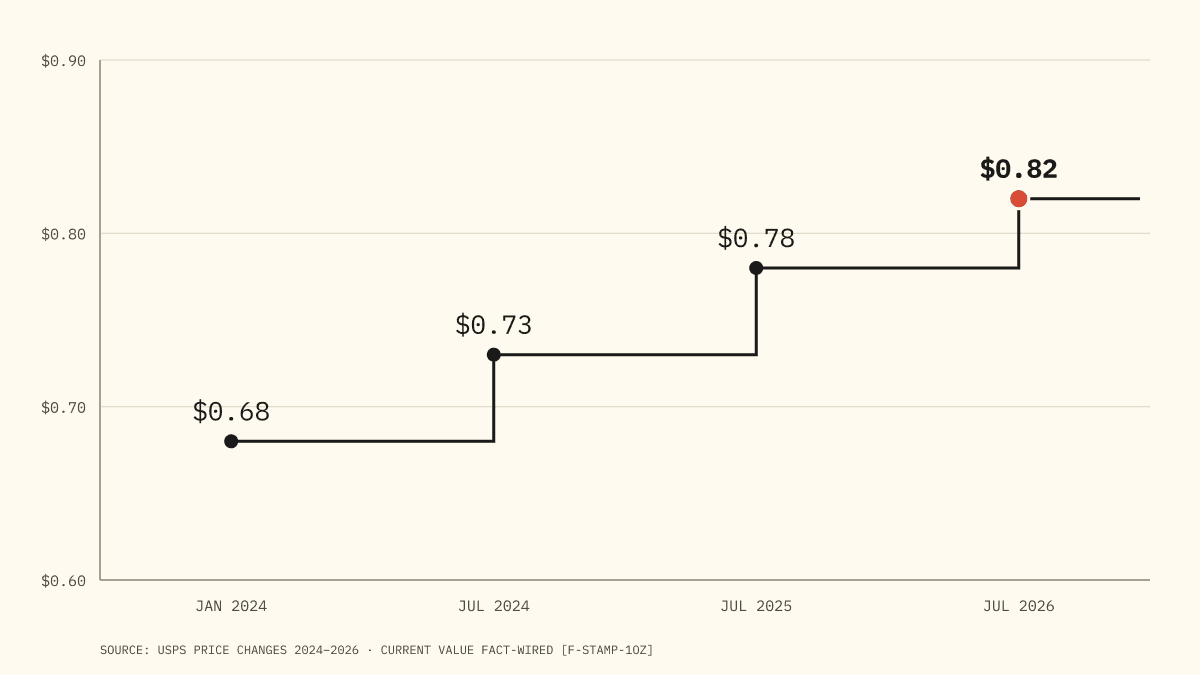
First-Class Mail rates have now risen three Julys in a row: the Forever stamp went from $0.68 to $0.73 in 2024, to $0.78 in 2025, and to $0.82 now. This page keeps every current First-Class rate in one place — by format and by weight — plus the discount you only get by skipping the stamp.
How much is a First-Class stamp right now?#
A First-Class Forever stamp costs $0.82, effective July 12, 2026.
The stamp is the price everyone knows, but it's only one of four First-Class prices. Metered postage is cheaper, postcards are cheaper still, and large envelopes cost about twice as much — the format decides the price before weight enters into it.
The format decides the price — a postcard is cheaper than a letter, a flat costs twice as much.
Format | Price | What it covers |
|---|---|---|
Letter, 1 oz — Forever stamp | $0.82 | The standard retail letter price |
Letter, 1 oz — metered | $0.78 | Meter or online-postage discount price |
Postcard — stamped | $0.65 | Cards within USPS postcard dimensions |
Large envelope / flat, 1 oz | $1.69 | Envelopes too big or rigid to be a letter |
Source: USPS rates effective July 12, 2026. Dollar values resolve from Postmarkr's verified USPS fact library.
One thing about Forever stamps: they keep their name's promise. Under USPS's Forever policy, a stamp bought at any price is always worth the current 1 oz letter rate, so stamps you bought at $0.78 still mail a letter today with nothing added.
First-Class letter rates by weight: what does each ounce add?#
Each additional ounce adds $0.29, up to the letter maximum of 3.5 oz.
Weigh the finished piece — after printing, inserting, and sealing — because the envelope and its contents count together. Past 3.5 oz, a letter stops being a letter: USPS prices it as a flat.
Metered postage saves a few cents at every weight; weight steps add far more than the meter saves.
Weight | Forever stamp | Metered |
|---|---|---|
1 oz | $0.82 | $0.78 |
2 oz | $1.11 | $1.07 |
3 oz | $1.40 | $1.36 |
3.5 oz (letter maximum) | $1.69 | $1.65 |
Each additional ounce | $0.29 | same step |
Nonmachinable surcharge | $0.49 | applies per piece |
Source: USPS rates effective July 12, 2026. Letters over 3.5 oz are priced as flats.
Watch the nonmachinable surcharge
Square envelopes, rigid mailers, and anything with a clasp, string, or button can't run through USPS sorting machines — each one costs an extra $0.49. If your letter fits a standard #10 envelope and bends, you avoid the surcharge entirely.
Why metered letters cost less than stamps#
A metered 1 oz letter costs $0.78 — four cents less than a Forever stamp.
USPS sets a lower price for postage printed through meters and approved online postage systems, and it applies at every letter weight, not just the first ounce. It's a commercial-channel price: you get it through a meter or an online postage account, not at the counter.
The spread is small per letter and real at volume: on 250 letters a month it's $10; on 1,000 letters, $40 — every month, on mail you were sending anyway.
Metered postage is the discount hiding in plain sight: same delivery, same envelope, four cents less on every letter.
Two things metered pricing does not change: delivery speed and add-on fees. If a letter needs proof — Certified Mail, Return Receipt — those fees stack on top of whichever postage rate you use. The certified mail cost guide prices those combinations.
How much are postcards and large envelopes (flats)?#
A stamped postcard is $0.65, and flats run $1.69 to $5.24 depending on weight.
Postcards are their own First-Class Mail category — don't pay letter postage for a card that fits postcard limits, up to 6 by 4.25 inches. Flats go the other way: anything past letter limits — larger than 11.5 by 6.125 inches, or thicker than a quarter inch — starts at $1.69 and climbs roughly thirty cents per ounce.
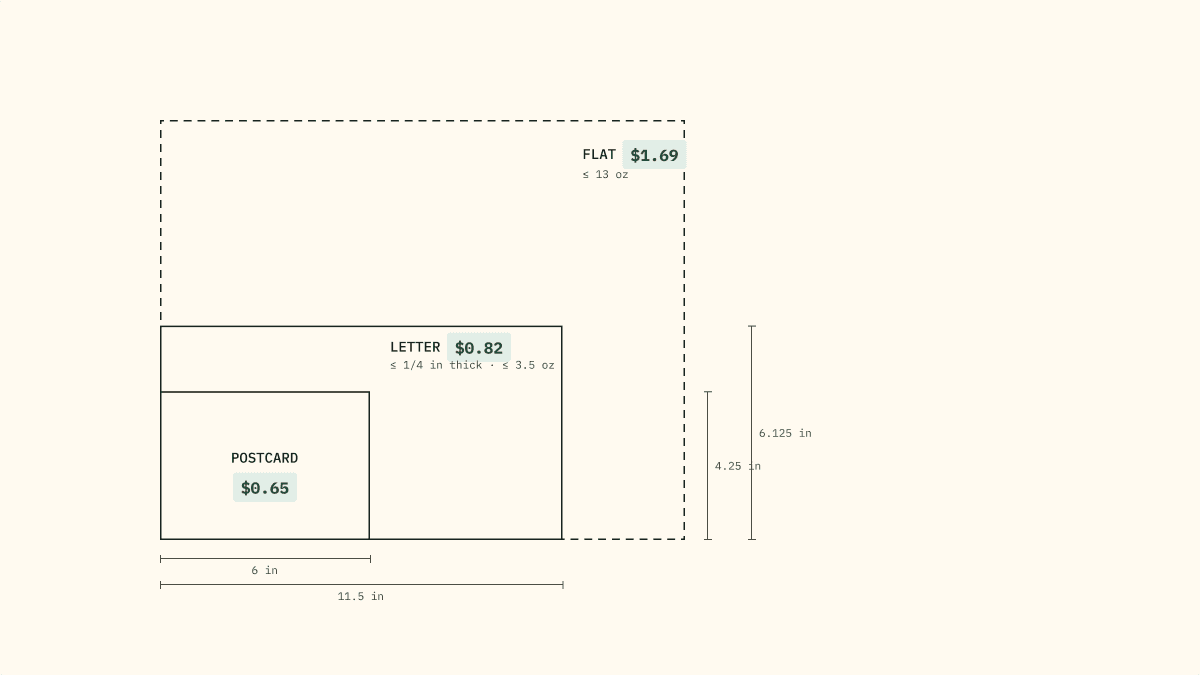
Flats step up roughly 29–31 cents per ounce all the way to the 13 oz maximum.
Weight | Price | Note |
|---|---|---|
1 oz | $1.69 | Starting flat price |
2 oz | $1.98 | |
3 oz | $2.27 | |
5 oz | $2.85 | |
8 oz | $3.72 | |
13 oz (flat maximum) | $5.24 | Heavier ships as a package |
Source: USPS rates effective July 12, 2026. Over 13 oz, the piece prices as a package, not First-Class Mail.
Thirteen ounces is the ceiling for all of First-Class Mail. Past it, the piece ships as a package — where Priority Mail starts at $11 — so up to that limit, a First-Class flat is the budget path for documents that can't fold.
How to choose the right First-Class rate#
- Identify the shape: letter, postcard, or flat — the size boundaries above decide, and shape sets the base price.
- Weigh the finished piece — printed, inserted, sealed.
- Use the rate in effect on the day USPS accepts the mail, not the day you print postage.
- Add anything extra your piece triggers: the nonmachinable surcharge, or proof services like Certified Mail, which charge their own fees on top of postage.
For a specific piece, the mail cost calculator prices it in under a minute.
Sending First-Class letters online#
If the real cost of your mail is the trip — printing, stuffing, stamping, and standing in line — the rate table isn't the whole answer.
Postmarkr sends standard First-Class letters online: upload a PDF, add recipients, and see the full price before checkout — from $2.05 per letter, covering printing, the envelope, First-Class postage, and handling. No subscription, no minimums. Use the USPS rates on this page when you're doing the mailing yourself; use the all-in price when you'd rather not.
Source and verification#
All rates on this page come from USPS Notice 123 and the July 2026 price files, current as of the July 12, 2026 price change. The “Sources checked” dateline on this page is computed from the oldest verification in our fact library, so it can only understate freshness — never overstate it. The tables resolve from our verified fact library — when USPS changes prices, we update the library and every table on this page updates with it. Always use the rate in effect on your mail's acceptance date.